Raspberry Pi Pico Board:
1. Introduction:
Raspberry Pi Pico is a low-cost, high-performance microcontroller board with flexible digital interfaces. It integrates the RP2040 microcontroller chip designed by Raspberry Pi, with dual-core Arm Cortex M0+ processor running up to 133 MHz, embedded 264KB of SRAM and 2MB of on-board Flash memory, as well as 26 multi-function GPIO pins. For software development, either Raspberry Pi’s C/C++ SDK, or the MicroPython is available. In this tutorial, we will use MicroPython.
2. Features:
RP2040 microcontroller chip designed by Raspberry Pi
Dual-core ARM Cortex M0+ processor, flexible clock running up to 133 MHz
264kB of SRAM, and 2MB of on-board Flash memory
Castellated module allows soldering direct to carrier boards
USB 1.1 Host and device support
Low-power sleep and dormant modes
Drag & drop programming using mass storage over USB
26 multi-function GPIO pins
2×SPI, 2×I2C, 2×UART, 3×12-bit ADC, 16×controllable PWM channels
Accurate on-chip clock and timer
Temperature sensor
Accelerated floating point libraries on-chip
8×Programmable IO (PIO) state machines for custom peripheral support
3. Parameters:
Microcontroller: RP2040 microcontroller chip
CPU: Dual-core Arm Cortex-M0+ @ 133MHz
USB-to-serial chip: Built-in USB1.1 PHY host and device support, drag-and-drop download program through USB identification as mass storage
Working voltage: 3.0V-3.6V
Working current: average 80mA
Supply current: 500mA
External power supply: DC power supply is 6-12V (recommended 9V), USB power supply is 5V.
Flash Memory: Built-in 2MB
SRAM: Built-in 264KB
Integrated crystal oscillator: 12MHz
4. Dimension Diagram:

5. Schematic Diagram:

6. Pin out
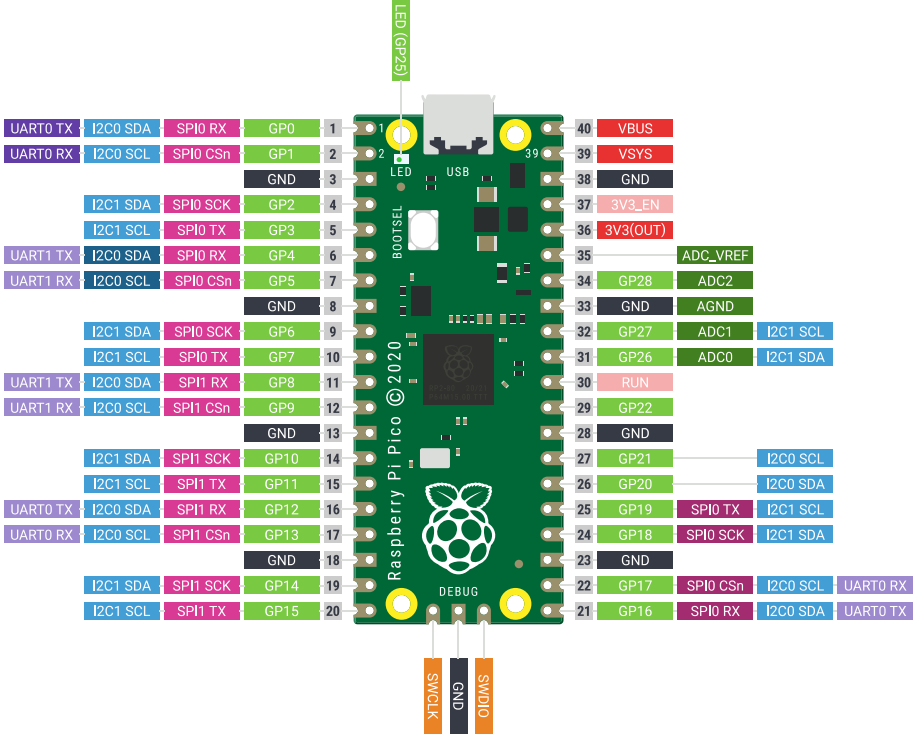

PIN |
FUNCTION |
|---|---|
GND |
Ground pin |
Power |
VBUS(microUSB voltage) |
System Control |
run (enable or disable the RP2040 microcontroller or reset) |
ADC |
Raspberry Pi Pico has a total of 5 ADCs with a resolution of 12 bits, |
PWM |
Raspberry Pi Pico has 16 PWM channels, |
UART |
Two UART: UART0,UART1 |
I2C |
Two types of I2C: I2C0 I2C1 |
SPI |
Two types of SPI: SPI0,SPI1 |
Debugging |
used in debugging code |